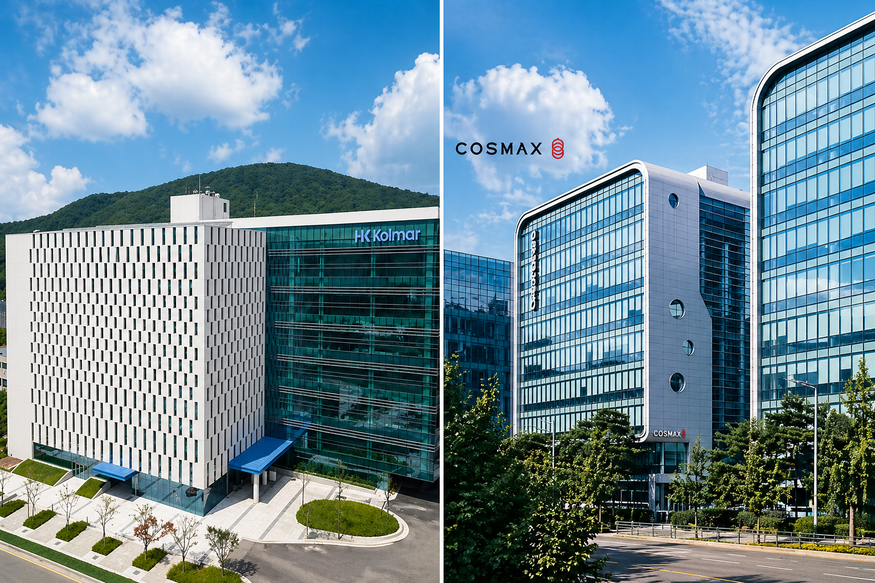
Four Korean contract manufacturers have disclosed domestic plant projects worth 563.8 billion won: Cosmecca Korea 200.0 billion, Kolmar Korea 173.3 billion, C&C International 130.0 billion and Cosmax 60.5 billion. The third-quarter filings explain the location. Cosmax earned 81% of its operating profit at home and Kolmar Korea's standalone business 77%, while all three of Kolmar's overseas units lost money. Every one of the four plants opens in 2027 or 2028, after the orders that justify it.
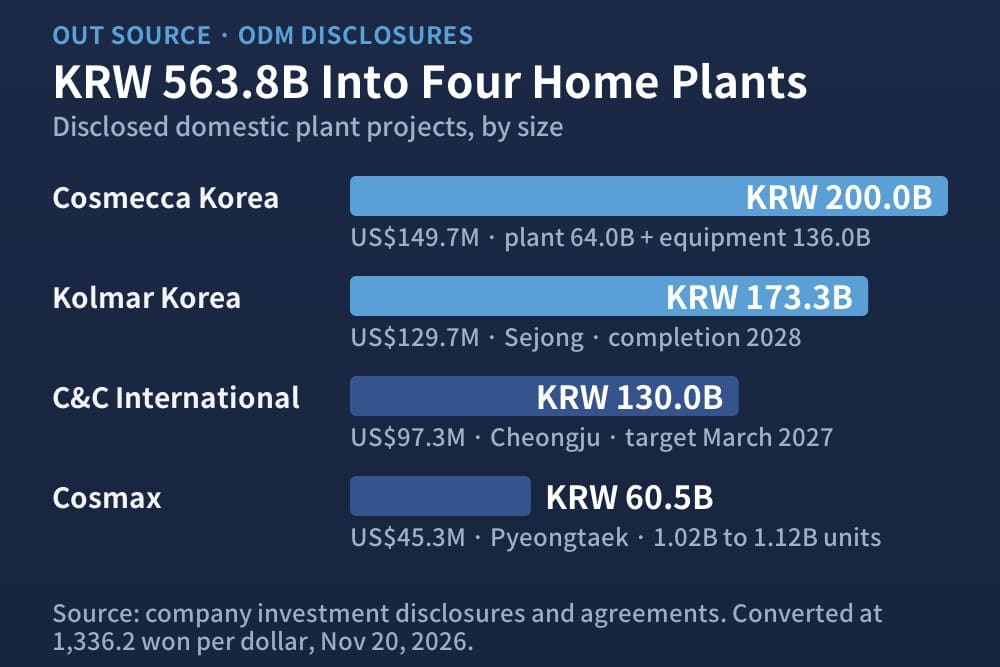
▲ Four Korean ODMs have disclosed 563.8 billion won of domestic plant projects, led by Cosmecca Korea at 200.0 billion won.
Where is the 563.8 billion won going?
Four disclosed projects add up to 563.8 billion won, or $422 million at the November 20, 2026 close of 1,336.2 won per dollar, the rate used throughout this article. Cosmecca Korea bought the Ochang plant in Cheongju in June for 64.0 billion won and committed 136.0 billion won to equipment there, 200.0 billion in total. Kolmar Korea signed an investment agreement with Sejong City on March 3, 2026 for a new plant at 173.3 billion won, with completion in 2028.
C&C International signed an agreement with Chungbuk Province and Cheongju City on August 13, 2025 for a 130.0 billion won plant, targeted for March 2027. Cosmax is putting 60.5 billion won into its Pyeongtaek plant. Contract manufacturers of this kind are called ODMs, for original design manufacturers: they develop formulas and fill orders for brands that own the label.
The Kolmar and Cosmax projects are basic cosmetics plants and lines. Basic cosmetics is the Korean industry term for skincare staples, as distinct from color makeup. The four projects differ in size by a factor of more than three, and all four sit inside Korea.
What do the third-quarter filings say about where the money is earned?
Cosmax reported third-quarter 2026 consolidated revenue of 875.8 billion won, up 49.6%, and operating profit of 83.3 billion won, up 94.9%. Its domestic operations produced 616.1 billion won of that revenue, up 61%, and 67.7 billion won of the operating profit, up 97%. Domestic operations are 81% of consolidated operating profit.
Kolmar Korea reported consolidated revenue of 828.2 billion won, up 21.3%, and operating profit of 81.9 billion won, up 40.5%. The standalone Korean business posted a record quarter: revenue of 433.7 billion won, up 34.7%, and operating profit of 62.9 billion won, up 42.0%. That is 77% of the consolidated figure.
Two manufacturers that earn more than three-quarters of their operating profit at home build their next plants at home. The capital follows the profit.
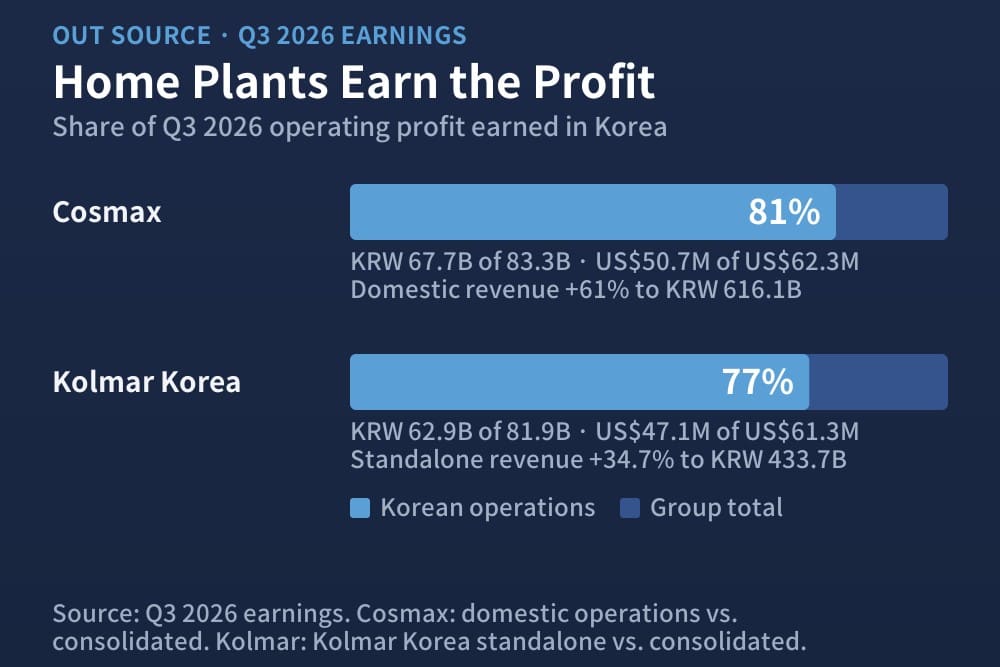
▲ Cosmax earned 81% of its third-quarter operating profit in Korea, and Kolmar Korea's standalone business earned 77%.
What did the overseas units do in the same quarter?
Kolmar's China unit widened its operating loss from 1.6 billion won to 4.4 billion won ($3.3 million). The U.S. unit lost 3.8 billion won ($2.8 million), a smaller loss than a year earlier. The Canadian unit lost 1.6 billion won ($1.2 million), up from 1.3 billion.
Kolmar is withdrawing its Beijing plant and moving that production to Sejong. When Sejong City announced the investment agreement, it described Kolmar as the first company of the year to return production to Korea under the national reshoring program, whose participants are called U-turn companies. Kolmar's second Pennsylvania plant, completed in July 2025, makes basic cosmetics and sun care. The first U.S. plant makes makeup.
Cosmax runs a different map. Its U.S. subsidiary stayed in operating profit in the third quarter, after its first profitable quarter in the second. Its overseas capacity in the pipeline is larger than its domestic base: a Shanghai smart factory designed for about 1.6 billion units a year, a Thai plant of 230 million units with a fourth-quarter 2026 start, and an Indonesian plant of 600 million units, about 73.0 billion won ($54.6 million), starting in the second quarter of 2027. That is about 2.4 billion units against a domestic base of 1.12 billion. The profit still comes home.
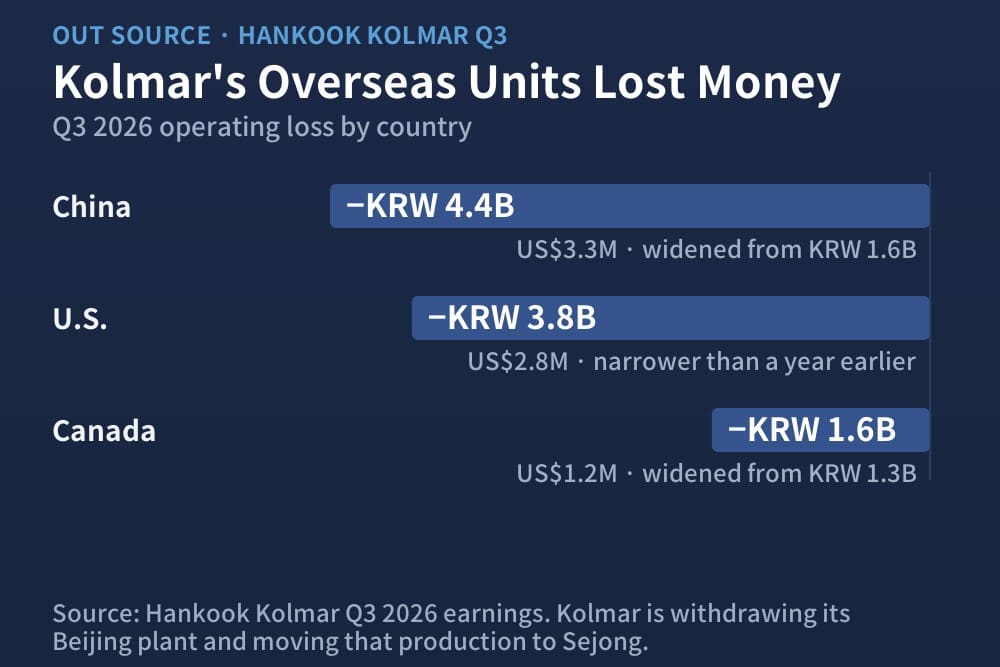
▲ Kolmar's China, U.S. and Canada units posted operating losses of 4.4 billion, 3.8 billion and 1.6 billion won in the third quarter.
Why is capacity, not demand, the scarce input?
In September, Kolmar and Cosmax were running their main domestic lines at effectively full capacity. The industry treats utilization above 70% to 80% as near the maximum. Kolmar Korea's standalone capacity grew from 373 million units in 2023 to 558 million in 2024 and 632 million in 2025, and its second-quarter 2026 utilization reached 84%. Both manufacturers had orders booked through year-end.
The fourth quarter is normally the slow quarter for contract manufacturers. The gap between peak and off-peak seasons is narrowing as K-beauty sells into more countries and as skincare, which is less seasonal, grows.
When every line is booked, revenue growth is a function of lines installed, not of demand won. A plant is the product a contract manufacturer sells, and the list of four projects is a list of lines.
Why do the new plants lean toward basic skincare?
Sejong is a basic cosmetics plant, and Pyeongtaek adds basic cosmetics lines. Basic products are more than 80% of Kolmar's output. Cosmax's domestic basic share rose from 56% in 2023 to 63% in 2025 and is expected to exceed 70% in 2026.
C&C International built its name in color cosmetics. Its Cheongju plant is designed to produce color cosmetics and skincare, and to take annual capacity from about 450 million units to more than 1.45 billion. The company announced it as an extension of its color strength into skincare.
The export numbers show which market the lines are for. Korea's cosmetics exports reached $11.1 billion in the first nine months of 2026, up 31.1%, according to the Ministry of Food and Drug Safety. The United States took $2.35 billion, up 40.6%, a 21.1% share. China, where Kolmar is closing its Beijing plant, took $1.58 billion, up 0.4%, a 14.2% share.
What does a 2027 or 2028 opening do to a 2026 order book?
The schedules run in a line. C&C International targets March 2027. Cosmax's Pyeongtaek expansion reaches full operation in early 2027, taking domestic capacity from about 1.02 billion units to 1.12 billion. Cosmecca's first phase at Ochang operates in 2027, with equipment added in stages through 2030. Kolmar's Sejong plant completes in 2028.
Every project opens after the quarter that justifies it. The order book that pays for the plants was written in 2026, the capacity arrives in 2027 and 2028, and the orders that fill it have to be signed in the gap between the two.
Who carries the utilization risk?
A contract manufacturer sells capacity. Its fixed cost is the plant, and its revenue depends on the share of lines that are booked. That share is currently high, with Kolmar Korea at 84% in the second quarter, and the four projects raise the number of lines it is measured against.
The brands that fill those lines carry the demand risk, and the manufacturers carry the utilization risk. When four builders add capacity in 2027 and 2028, the question a brand asks a plant moves from who has a free line to who offers the best terms for one. The lines are the same. The bargaining position is not.
Where does K-beauty's manufacturing base sit?
The list of four is a list of addresses in Cheongju, Sejong and Pyeongtaek. Those are where the quarter's profit was made and where the next lines go. What fills them is the order book that starts being written now.