RXme, a pharmacy-only skincare brand from the Seoul startup PharmAce, sold out its post-procedure firming cream on November 17, 2026, and its cream sheet mask followed within days. Both co-CEOs are licensed pharmacists, and they say the first large pharmacies they approached refused to stock the brand. The refusal set the order of the business: consumer demand first, pharmacy pull second, then business-to-business exports. Exports now reach eight countries, and the pitch changes in each.
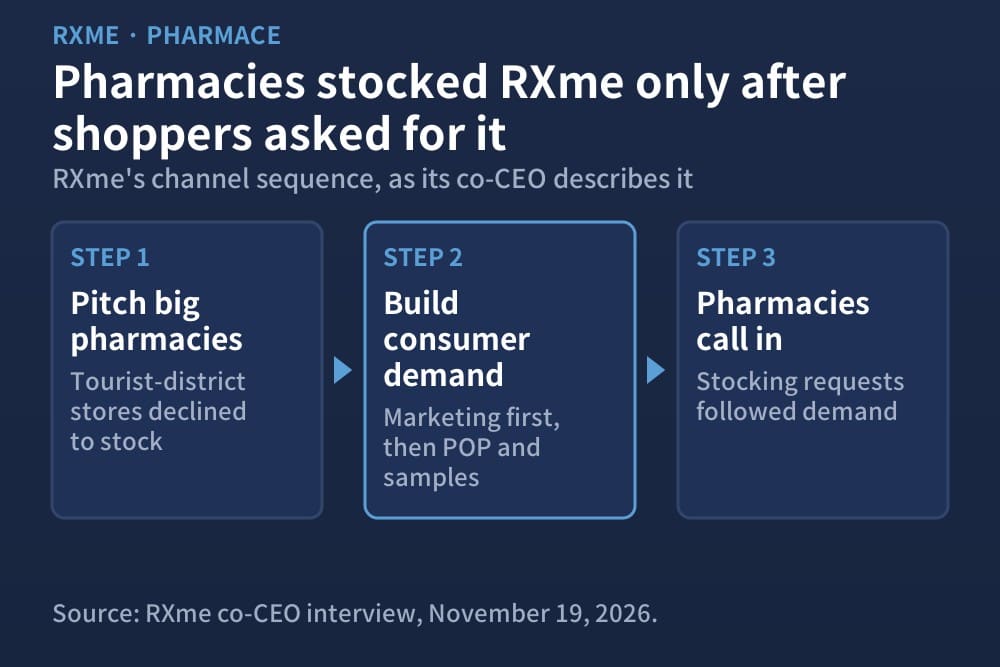
▲ A pharmacy-first sequence: pitch pharmacies, build consumer demand, then take stocking requests from the pharmacies that call in.
Who is behind RXme, and what is PharmAce?
PharmAce was founded by the pharmacists who serve as its two co-CEOs. It runs two brands: RXme, a skincare brand sold only through pharmacies, and an inner-beauty brand that has operated for about five years. A pharmacist brand marketer on the team reviews the scientific evidence behind each product and trains pharmacists.
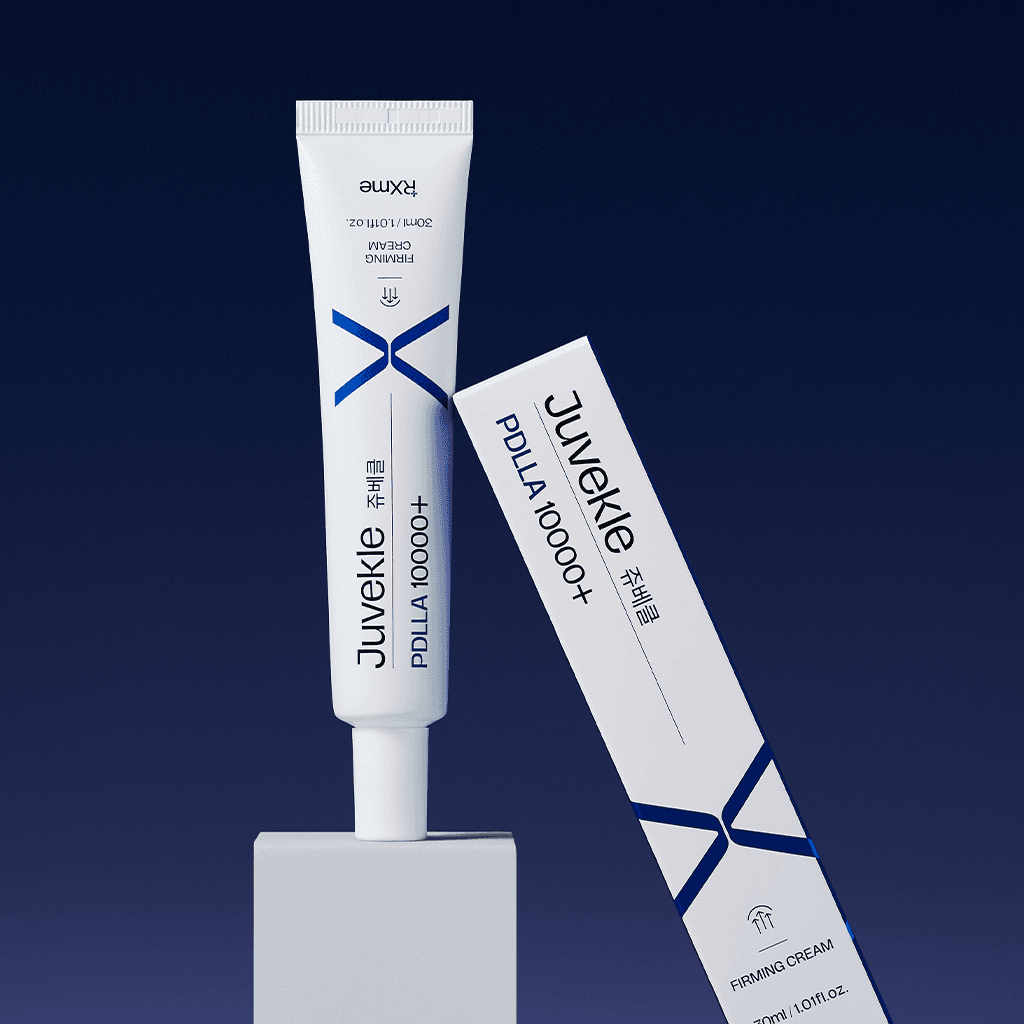 ▲ RXme Juvekle PDLLA 10000 Plus Firming Cream from PharmAce official store (rxmecosmetics.com)
RXme launched last year. Its first cream came out in September 2025 and its second product followed a month later, built for post-procedure care. A cream sheet mask joined the line afterward.
The team chose pharmacies as its domestic priority channel because a pharmacist can explain a product and counsel a customer in the same conversation. The company frames the pharmacy not as a sales point but as the place that manages care after dermatology procedures, and it lets pharmacist input shape product planning and formulation. Within six months of launch, field feedback led it to upgrade a formulation.
The product thesis is that a pharmacy brand has to survive a pharmacist's questions. The co-CEOs said a product must be one a pharmacist can take responsibility for and explain on the basis of evidence.
Why did the first pharmacy pitch fail?
The co-CEOs began by visiting large pharmacies in tourist districts themselves, the stores with the most foreign visitors. None of them stocked the brand. The co-CEO said pharmacies buy only what shoppers will buy, and with no demand behind the product, no pharmacy bought it.
Tourist-district pharmacies have the foot traffic, which is why the founders went there first. Foot traffic did not turn into a stocking decision, because that decision rests on what the pharmacist expects to sell.
A pharmacy is a gatekeeper with a simple rule. Shelf space goes to products that already move, and a new brand without a track record has nothing to show.
The failure carried information. It told the founders that the sales pitch to the pharmacy was the wrong first move.
What did they change?
They reversed the sequence. The team put its effort into marketing to consumers first, so that shoppers asked pharmacies for the product by name. Pharmacies then began to contact the brand, and the co-CEO said the brand stood out in the pharmacy because of that.
Before launching the second product, the team placed lab samples and a point-of-purchase (POP) display in pharmacies that showed the area of the face the product treats, and watched the reaction. Content, visual merchandising, POP and packaging then all carried the same application-area cue.
The pharmacy shelf became a place where demand shows up, not where it gets made.
How does a pharmacy-only channel create pull?
The pharmacist is the filter. A product has to pass the person who recommends it, so RXme supplies pharmacists with consultation materials and multilingual guides, scientific material for pharmacists and customer reviews for shoppers. It plans a pharmacist community, RXme Lab, and calls pharmacists who sell its products growth partners. Supply runs through the wholesaler Baropharm and the company's own online mall.
The two audiences get different material because they ask different questions at the counter. The pharmacist asks whether the product can be recommended, and the shopper asks whether it is for them.
The demand on the pharmacy side is visible. A pharmacist near Busan's Jagalchi Market said foreign customers make up nearly half of the pharmacy's visitors and now ask for skin elasticity and anti-aging products first, where they once asked for everyday medicines or red ginseng. The pharmacy's cosmetics sales rose about 30% after it began stocking RXme's firming cream, the pharmacist said.
Foreign shoppers buy in multiples and pay higher unit prices than domestic customers, the pharmacist said, and they return by word of mouth.
How did exports start?
Exports began as business-to-business (B2B) trade with overseas buyers, and last year's volume went mostly to Taiwan. This year the destination count reached eight countries. In the first half, sellouts forced the team to serve the domestic market first, and the export push began in the second half.
Foreign shoppers who bought in Korean pharmacies fed the foreign side. Their repeat purchases extended the brand's reach overseas, and Japan produced the most repeat demand because the products come in small sizes with a short repurchase cycle.
Pharmacies in tourist districts such as Myeongdong, Seongsu and Gangnam, the kind of store that declined RXme at first, are where foreign shoppers now find it.
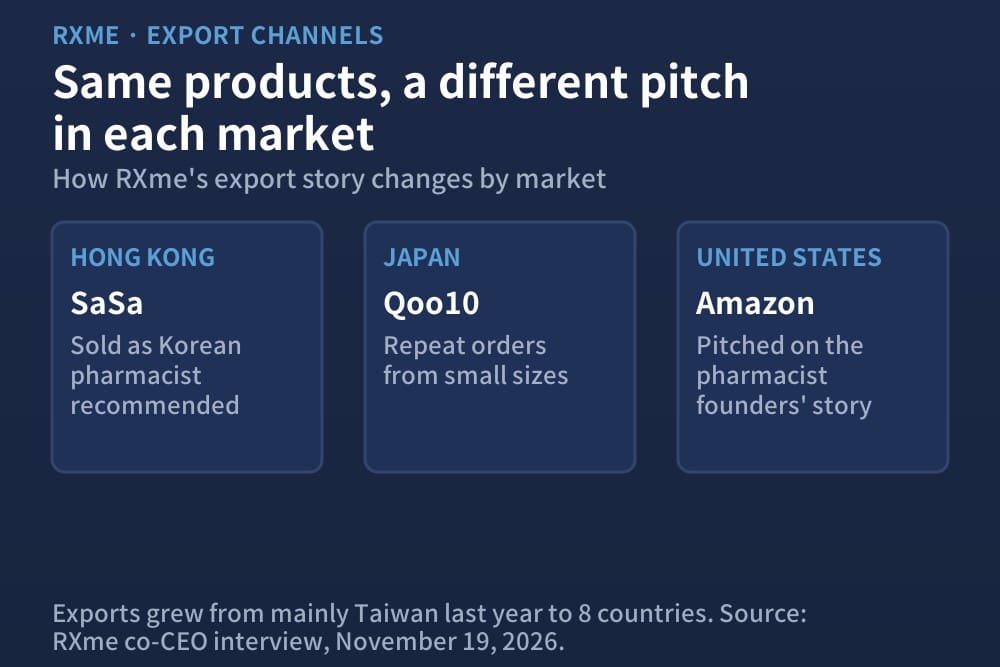
▲ Same products, a different pitch in each market: SaSa in Hong Kong, Qoo10 in Japan and Amazon in the United States.
Why does the pitch change by market?
In Japan and Chinese-speaking markets, a Korean pharmacy is a stop on the shopping route, and shoppers trust a pharmacist's recommendation. RXme sells its two main products there as recommended by Korean pharmacists.
In the United States, a Korean pharmacy means little to shoppers. The pitch there is the founders' story: Korean pharmacists designed the products. The U.S. channel is Amazon, and the brand reaches customers through it.
The channel list follows the pitch. In Hong Kong the brand is on the shelves of every SaSa store, the beauty retail chain. In Japan it listed on Qoo10, an online marketplace, and ranked among the top new skincare brands at a large sale event. A two-week Stanford accelerator program selected about 12 Korean brands, RXme among them, and the team ran three pop-ups through it.
What comes next?
RXme plans to triple revenue in 2027 against this year, widen its product lineup by skin concern and expand sales channels country by country. It plans to grow direct sales in Japan and the United States in 2027, and it keeps its focus on basic skincare while leaving room to expand with demand.
The brand also holds a pharmacist event, K-Dermacon Seoul 2027, where it invites pharmacy owners to discuss dermacosmetics and market direction and unveils new products.
The pharmacy remains the domestic priority channel in that plan. The new sales channels sit around it, in Japan and the United States, where the brand is adding direct sales next to its B2B partners.
The plan leaves the pharmacy at the center and adds direct sales around it.
What does RXme's sequence say about channel design?
A gatekeeper channel works as a verifier, not as a source of demand. The pharmacy confirms that shoppers want a product, and the pharmacist adds credibility once they do.
RXme's order runs demand, then pharmacy pull, then B2B export, then direct sales. Each step rests on proof from the step before it.
In a gatekeeper channel, the shopper is the first buyer and the retailer is the second.