Starstech began as a Korean deicer maker, turning starfish, a marine waste product, into a road deicer that corrodes less. A July 22, 2026 report put its annual sales at about 26 billion won (US$19.5 million at the November 20, 2026 rate of 1,336.2 won per dollar). In 2022 the company launched LABOPE, a skincare brand built on Penellagen, a patented starfish collagen. On November 11, 2026, LABOPE took the ingredient to Cosmoprof Asia in Hong Kong and held talks with buyers about entering Europe.
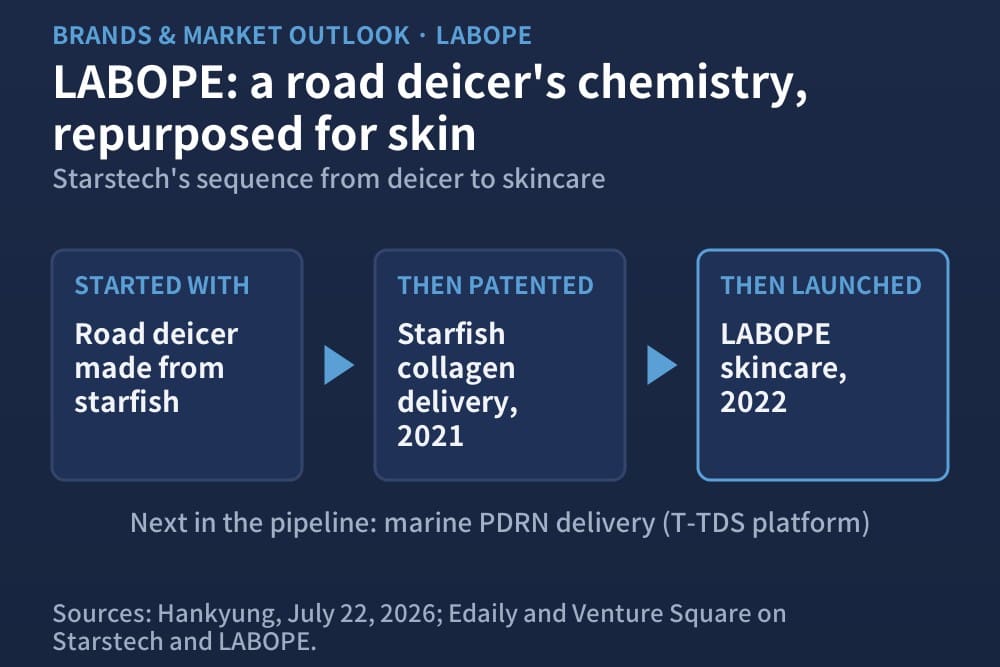
▲ Starstech's path runs from a starfish-based deicer to a patented collagen in 2021 and the LABOPE brand in 2022.
How does a road deicer end up in a skincare jar?
Yang Seung-chan, Starstech's CEO, founded the company at 21 while studying chemical engineering at Seoul National University and left school to run it. The idea came during his military service in Inje, Gangwon: he wanted a deicer that would not corrode roads and found the porous structure of starfish suited to it. The report says the company reached its current size in about ten years.
Starfish are a marine waste problem. They prey on farmed seafood and are a nuisance to fishermen, so the raw material arrives with a clean-up story attached. Starstech extracts a compound that reduces corrosiveness and uses the leftover byproducts, which lowers the cost of the deicer.
The company then extended its starfish process technology, first built for the deicer, into cosmetics. Yang said Starstech plans to expand into cosmetics and medicine using the process technology it secured in the deicer industry.
What is Penellagen?
Penellagen is a patented collagen ingredient derived from starfish. Starstech pairs it with elastic ethosome technology, abbreviated TDS for transdermal delivery system. An ethosome is a lipid vesicle designed to carry an active ingredient into the skin.
Starstech received a patent in 2021 for technology that delivers the starfish collagen to the dermis, the skin layer below the surface. The ingredient has its own name, its own patent and its own delivery system before the consumer brand exists.
Hwahae's English brand page positions LABOPE as premium anti-aging skincare aimed at aging skin, loss of elasticity and wrinkles, with Penellagen as the key ingredient. The positioning matches the delivery claim: an anti-aging product has to reach the dermis to matter.
Why build the ingredient before the brand?
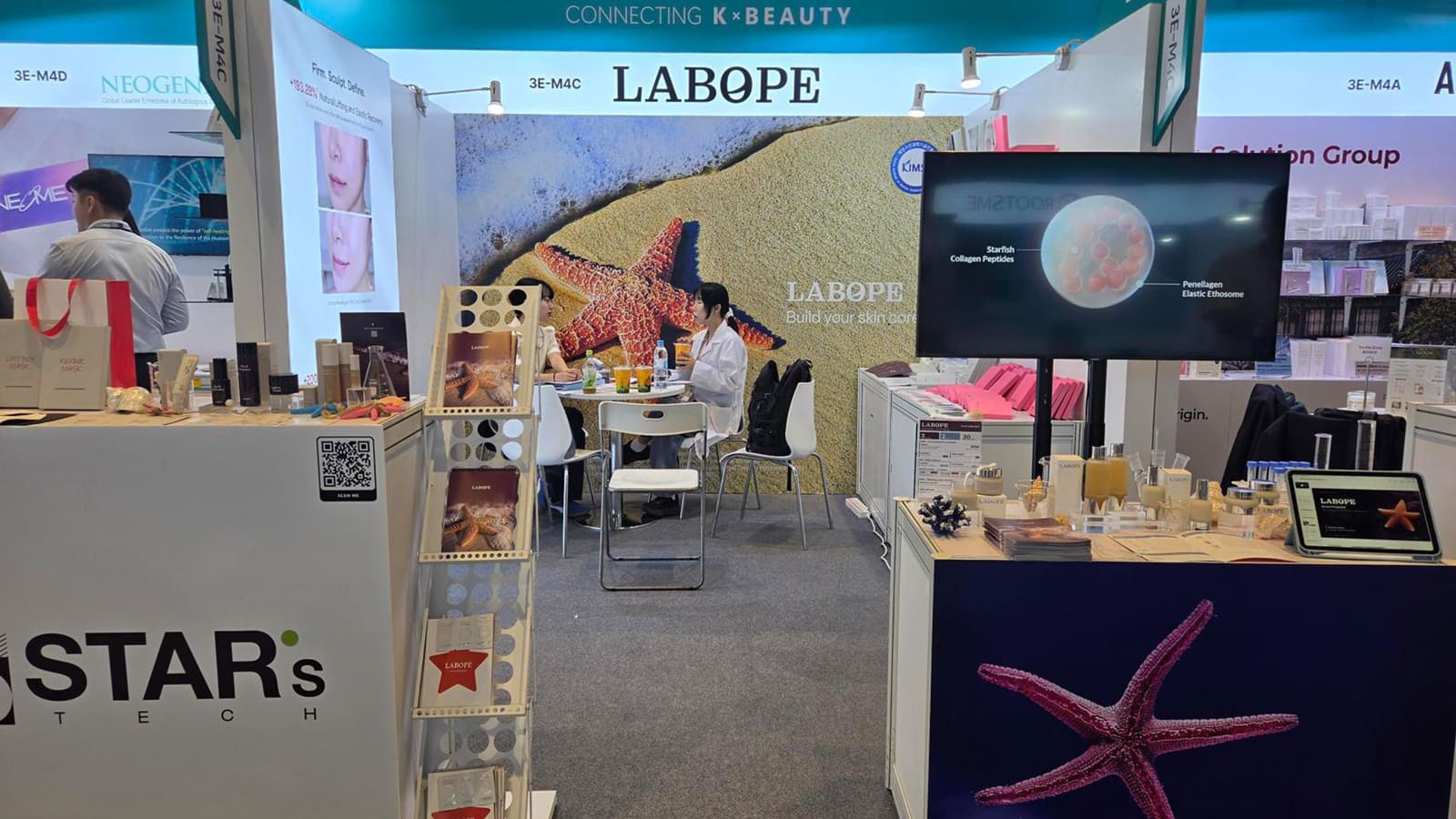
▲ Starstech’s LABOPE showcasing its Penellagen starfish collagen skincare line at Cosmoprof Asia 2026 in Hong Kong. Photo: Starstech
The sequence is patent in 2021, brand in 2022. An ingredient with a name and a patent can be sold two ways: to formulators as a material, or to shoppers as a brand built around it. Starstech built the second.
The ingredient also gives the brand a claim the shopper can repeat: starfish collagen, delivered by a patented system. In a category crowded with collagen claims, a named material with a documented origin anchors the brand's story. The brand name, LABOPE, and the ingredient name, Penellagen, sit side by side on every product.
A patent plays differently for two audiences. A distributor reads it as a reason to list the brand, and a shopper reads an ingredient name as a reason to try it. The same asset has to be told twice, in two registers.
What is in the LABOPE range?
The Enhance line has three products for skin elasticity and hydration. The rest of the range includes the Quick Repair Water Gel Mask, the Lifting Hold Cream Mask, the LightSafe Sunscreen, the Core Pack Cleanser and a Prep Heart Patch made with Sino Seoulbase.
By July 2026 the brand had been rebranded for global markets and a new sheet mask had followed. Products across the range use starfish-derived ingredients and the in-house TDS technology, so masks, sun care, cleansing and patches all carry the same ingredient story.
A range this broad for a company this size is a wager that the ingredient, not the format, is the brand. If shoppers recognize Penellagen, each new format is a line extension rather than a new launch.
Where does LABOPE sell?
In Korea, LABOPE sells through its own online store, Naver Smart Store, Coupang and Hwahae, a beauty review and ranking platform, and is expanding offline through pharmacies in Gangnam and Myeongdong. Overseas, it uses Amazon in the United States, Qoo10 in Japan, and Douyin and Xiaohongshu in China.
The mix is online-first with a pharmacy layer. Pharmacies sit between medical and beauty retail, which suits a brand whose pitch is a patented ingredient and a delivery system. Europe is the first market where the stated plan is to find distribution partners.

▲ LABOPE sells through four online channels and pharmacies in Korea and through four platforms overseas; Europe is the market it is now negotiating.
What do shoppers on Hwahae say?
Hwahae's English brand page lists LABOPE with an average rating of 4.42 from 182 reviews. The concerns that come up most often are the price, a divisive fragrance and a short or stiff dropper on the Penellagen Youth Activator serum.
Those are the complaints of a premium product with a specific audience: shoppers willing to pay for the ingredient story and critical of the details around it. A price objection comes from a buyer who is still in the market.
What happened in Hong Kong?
LABOPE exhibited at Cosmoprof Asia 2026 at the HKCEC in Hong Kong on November 11, 2026. The show, in its 29th edition, drew more than 2,800 companies from 43 countries and over 78,000 industry visitors. LABOPE showed its patented ingredients and skincare line to overseas distributors and partners. Cosmoprof Asia is a B2B beauty exhibition, so the audience is distributors and buyers rather than shoppers.
Yang said the show was a chance to put LABOPE's bio-technology and product strength in front of overseas buyers, and the company held talks with buyers about entering Europe. Its plan is to seek distribution partners in new markets, Europe among them, on the strength of those contacts.
At a show of that size, the first output is introductions. LABOPE's stated next step is distribution partnerships country by country, which makes each introduction a candidate for one market.
Why does a materials company make a consumer brand?
Yang said Starstech will expand into cosmetics and medicine using process technology built in the deicer business. The plan names new raw materials for the deicer line, sea urchins and acidic waste from semiconductor and display manufacturing, and a research track on applying TDS to injectables and other medical uses, including inflammation treatment.
The cosmetics pipeline runs on research into a platform called T-TDS, which delivers marine-derived PDRN to specific cells. PDRN, polydeoxyribonucleotide, is a DNA-fragment ingredient used in Korean skincare. The work extends Starstech's marine material research beyond starfish collagen.
A company that owns a process technology and a source of waste feedstock can launch a consumer brand, an ingredient and a medical research track from the same base. The brand is the most visible of the three, not the only one.
What can other independent brands take from this?
A brand with a documented raw-material origin starts with a story that needs no invention: the starfish is a clean-up problem solved. A brand with a patented ingredient starts with a claim that competitors cannot copy by buying the same bulk collagen. A brand with a parent in another industry starts with a business that already runs outside beauty.
The cost of that structure is focus. LABOPE competes in skincare against brands whose only job is skincare, and its next step, a European distributor, is a question the deicer business cannot answer.