Taekwang Industrial, a Korean industrial group, paid about 35.1 billion won (US$26.1 million at 1,342.4 won per dollar on November 24, 2026) for 36.8% of the structure behind Dr. AGA Clinic, a 15-clinic Japanese hair-loss chain. The group closed its Aekyung Industrial purchase on March 26 and announced a Dongsung Pharm deal on January 14. It now holds a hair-care maker, a hair-loss drug maker and the room where a patient gets a recommendation. Taekwang bought a channel, not a brand.
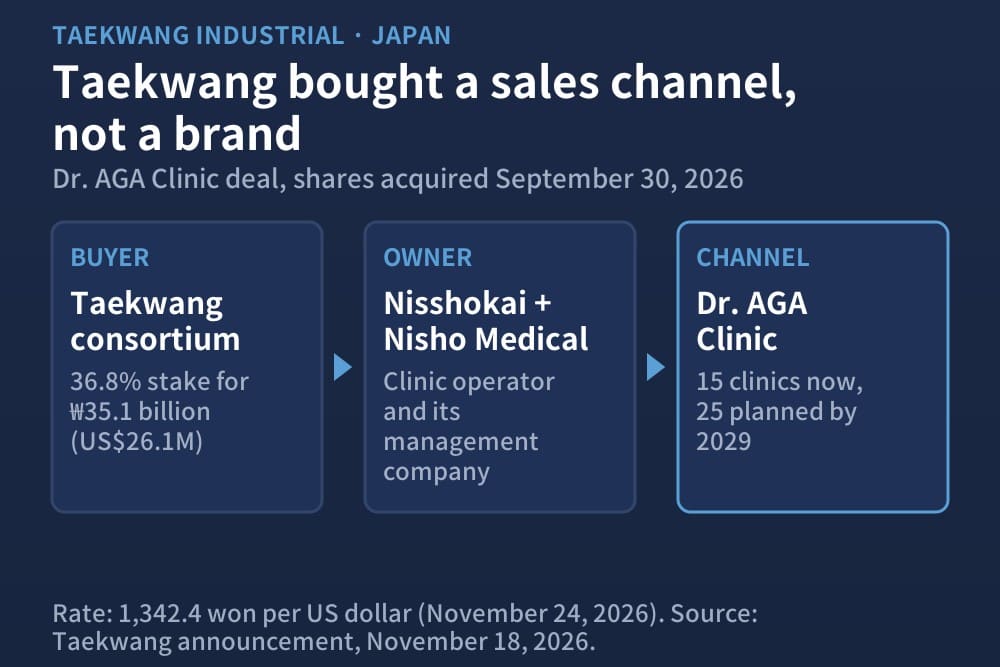
▲ Buyer, owner, channel: a Taekwang-led consortium holds the structure behind Dr. AGA Clinic's 15 clinics, with 25 planned by 2029.
What did Taekwang actually buy?
Taekwang formed a consortium with the private equity firm Invictus PEF and the medical device maker Wontech to take part in acquiring the structure behind Dr. AGA Clinic. Two entities sit inside it. Nisshokai, a medical corporation, provides the medical services. Nisho Medical is a management services organization (MSO), a company that runs the non-medical side of a clinic network: opening new branches, marketing and customer consultation.
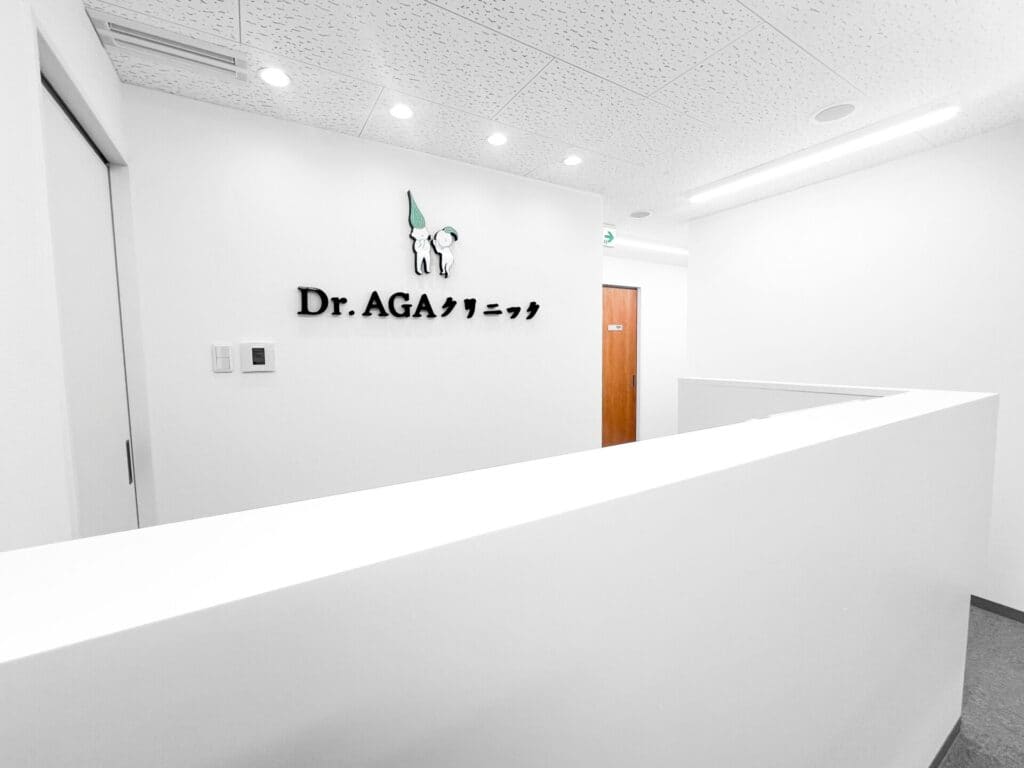 ▲ Dr. AGA Clinic reception in Shinjuku, Tokyo (drskinclinic.jp)
Taekwang's share is 36.8%, for about 35.1 billion won. The timeline is short. The share purchase agreement was signed on September 21, payment and share acquisition were completed on September 30, and Taekwang announced the deal on November 18.
The clinics themselves operate in major Japanese cities including Tokyo and Osaka. The network has 15 clinics today and plans 25 across Japan by 2029.
The consortium pairs capital, a medical device maker and a group with a product line to supply. Each partner brings a different asset to the same clinic network, and the supply role belongs to Taekwang's affiliates.
Why is a clinic different from buying a brand?
A brand acquisition buys a name, a formula and a shelf position, and the buyer still has to win the customer. A clinic network buys the customer relationship at the point of diagnosis.
A Taekwang official said the clinic gives the group a firm sales and treatment channel that speeds up the entry of its hair-loss and hair-care products into Japan. The sentence names the asset precisely: a channel where treatment and sale happen in one visit.
A clinic network also scales differently from a brand. Each new clinic adds a room, staff and a physician, so growth is paced by openings. Going from 15 clinics to 25 by 2029 means ten new clinics, and every one of them is a new point of sale.
For a hair-loss product, that sequence matters. The patient arrives with the problem, a clinician examines it, and the recommendation comes from the person who just did the examining. No advertising budget buys that moment.
Which products travel through the channel?
Two Taekwang affiliates supply the products. Dongsung Pharm brings hair-loss treatments, and Aekyung Industrial brings hair-care products. Since November a cooperation council has run the planning between the clinic side and the two suppliers.
The council discusses supply of both product groups through the clinics and the possibility of OEM manufacturing, in which a contract manufacturer produces goods that another company sells under its own name. In the long run Taekwang plans to develop private-label (PB) products jointly for the Dr. AGA clinics and to extend into Japanese and global scalp and hair-care markets.
The sequence is supply first, then own label. Taekwang starts by placing existing products in the room, and the clinic's own brand follows once the volume exists.
How did Taekwang assemble the supply side?
The group built the product side before it bought the channel. Taekwang's board approved the acquisition of Dongsung Pharm on January 7, 2026, and the deal went public on January 14 with a plan to build a beauty and healthcare platform spanning pharmaceuticals, hair dye, dermatology products, hair care and cosmetics. Taekwang set up SIL, a cosmetics-focused subsidiary, ahead of the purchase. The plan also listed a shift of Dongsung's production toward ODM and OEM work, and affiliate sales channels such as home shopping, media commerce and hotels for commercialization and marketing.
ODM (original design manufacturing) means a manufacturer designs and makes products that other companies sell under their own labels. The clinics add a channel of a different kind to that list, one staffed by clinicians, not by broadcast hosts or hotel desks.
Aekyung Industrial closed on March 26. At a September 4 press meeting, Aekyung said hair care makes up about 20% of its total sales and targeted at least 25% in 2027. Aekyung said over half of its hair-care revenue from January to July came from overseas, with the strongest growth in Russia and the CIS, the Americas and Europe.
Japan is not on that list of growth regions. It is the market Taekwang bought its way into.
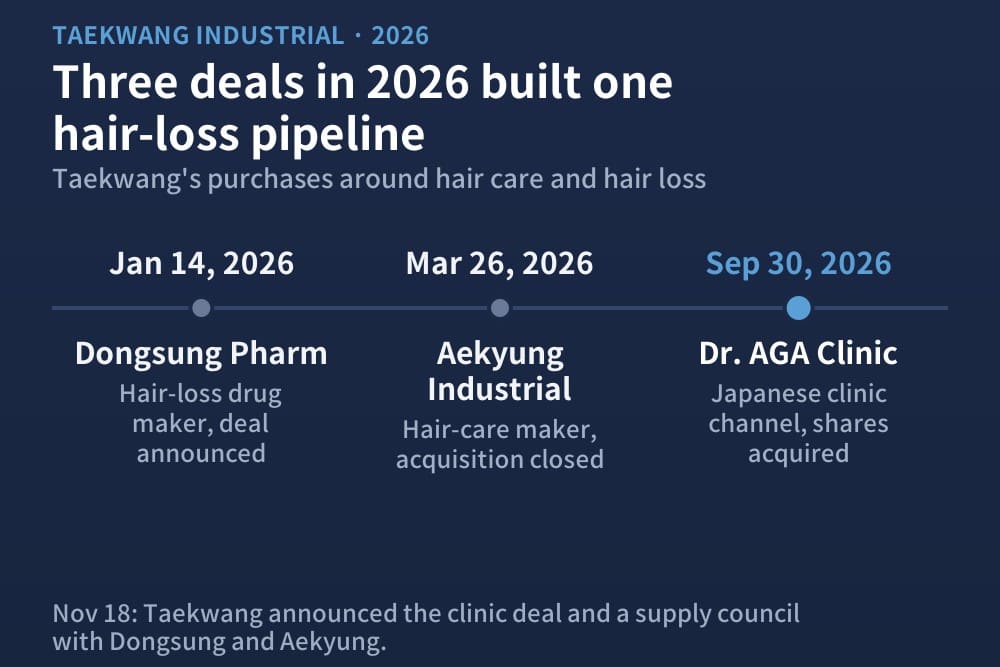
▲ Three purchases in 2026: Dongsung Pharm announced January 14, Aekyung Industrial closed March 26 and the Dr. AGA Clinic shares acquired September 30.
What does Aekyung's hair-loss brand add?
Aekyung's hair-loss brand Blackfore launched in January 2023, and Aekyung has proposed sales at Watsons in Taiwan and Hong Kong, a proposal under positive consideration. It plans to enter Costco in the United States in 2027. Aekyung is also pursuing a collaboration with Dongsung to apply Dongsung's hair-loss expertise to Blackfore leave-in products.
So the product side already runs on two tracks. One track is retail, where Blackfore moves toward Watsons and Costco. The other is the clinic, where treatment and hair care reach the patient together.
The clinic track gives Taekwang something the retail track cannot: a professional recommending the product in the same appointment as the treatment.
How does a clinic channel differ from a drugstore shelf?
An open shelf sells to whoever walks by, and it competes on price, placement and packaging. A clinic sells to a patient the clinician has already examined, and it competes on the clinician's judgment.
Hair loss is a category where that difference counts. The buyer is a patient, the recommender is a clinician, and repeat purchase is built into the course of treatment. A channel that sits inside that course captures the first purchase and the refills.
The clinic also changes who the customer is. A drugstore shopper chooses among brands. A clinic patient follows a treatment plan, and a plan names products. That keeps the supplier list inside a clinic short, and the first suppliers on it set the pattern for the ones that follow.
The cost of the clinic route is scale. A network of 15 clinics reaches far fewer shoppers than a drugstore chain does, so the plan to grow to 25 by 2029 carries the volume case.
What does the deal say about outsider groups entering beauty?
Groups from other industries enter beauty by purchasing assets that already hold customers. Taekwang came from petrochemicals and textiles, and it chose to buy a pharmaceutical supplier, a consumer hair-care company and a patient channel, not to build a brand from nothing.
The order of purchases tells the strategy. Products first, then the channel that carries them, and then the shared label that the channel allows.
For a hair-care maker the clinic is a distribution partner. For a drug maker it is a prescriber. For an investor it is a business with its own growth plan, 25 clinics by 2029.
Channel first, brand second. In hair loss, the group that owns the clinic room sets the terms for everyone who wants a product in it.