On November 27, Dongkook Pharmaceutical shareholders retired a name used since 1982. The replacement, DK Centellian, belongs to a cosmetics brand launched in 2015. In 2025, prescription and over-the-counter drugs still made up 43.0% of the company's ₩926.9 billion (US$695 million, at 1,333.5 won per dollar, the November 27, 2026 rate) in revenue, against 34.1% for the healthcare division that holds the cosmetics. Dongkook renamed itself after its fastest-growing business, not its largest.
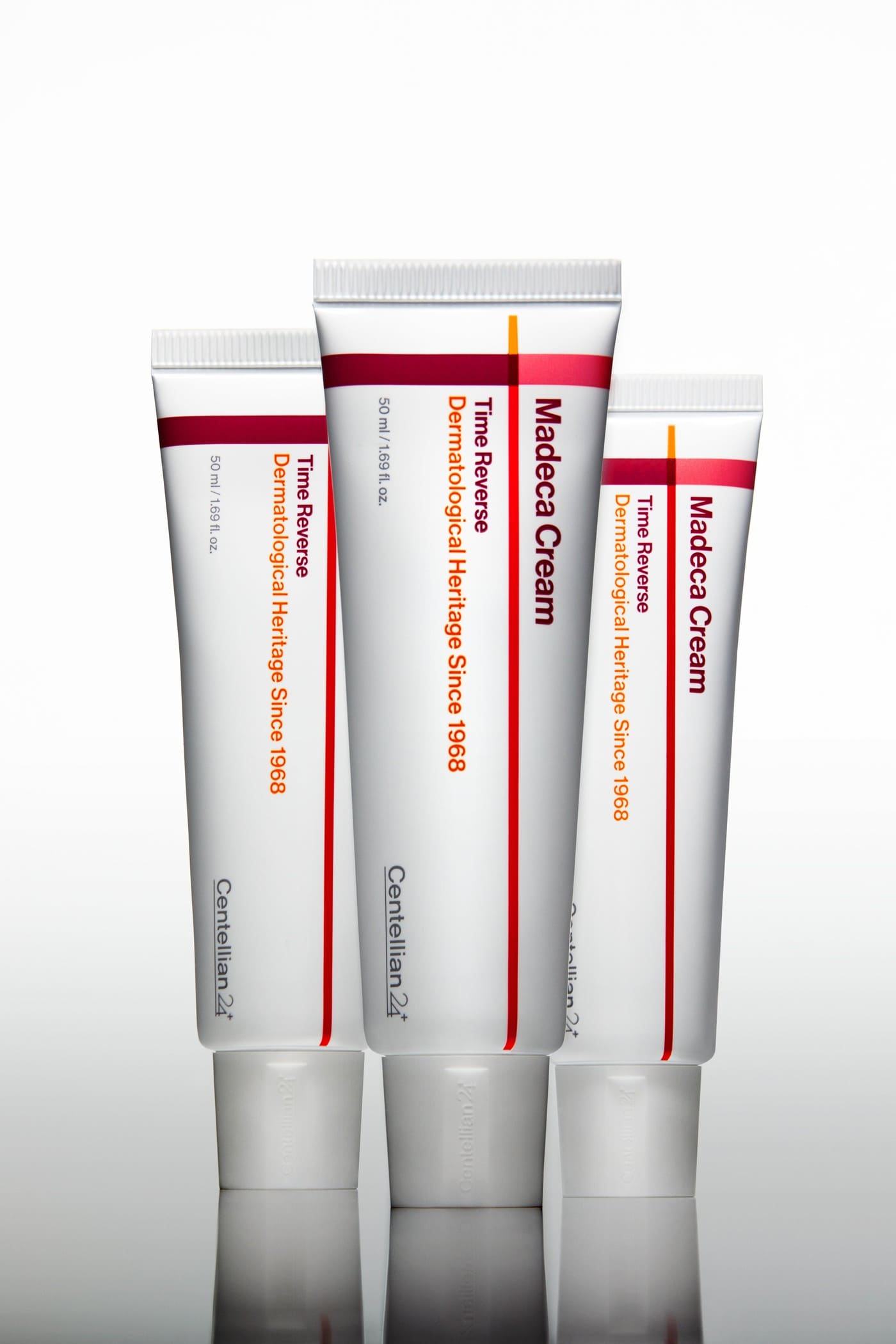
▲ Madeca Cream Time Reverse, the Centellian24 cream that reached about 1,400 Ulta stores in the United States. Image: Centellian24
What did shareholders actually approve on November 27?
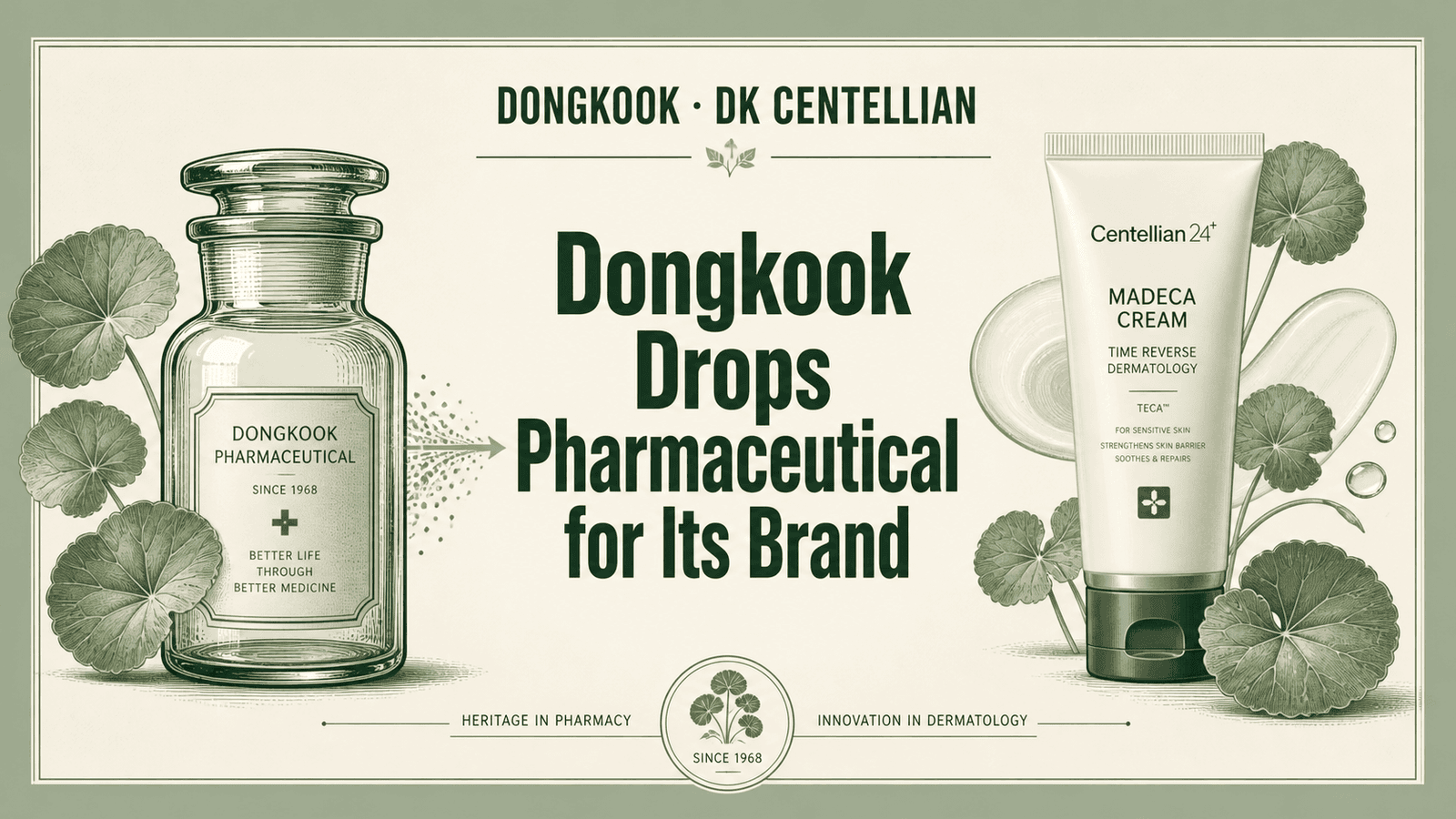
At an extraordinary shareholders' meeting at its Seoul headquarters in Gangnam-gu, Dongkook Pharmaceutical won approval for a partial amendment to its articles of incorporation, the charter document that fixes a Korean company's legal name. The legal name changes from 동국제약 (Dongkook Pharmaceutical Co., Ltd.) to 디케이센텔리안 (DK Centellian Co., Ltd.). The board had approved the proposal on October 12.
The vote cleared the bar for a special resolution, which requires two-thirds of the votes of attending shareholders and one-third of all issued shares. Of the votes cast, 99.8% were in favor. Dongkook's filing the same day gave the purpose as business expansion and a stronger global market-entry strategy.
The company had carried the old name since 1982. In explaining the new one, Dongkook said that DK stands for 58 years of history and scientific trust, and that Centellian stands for the expertise it has built up since.
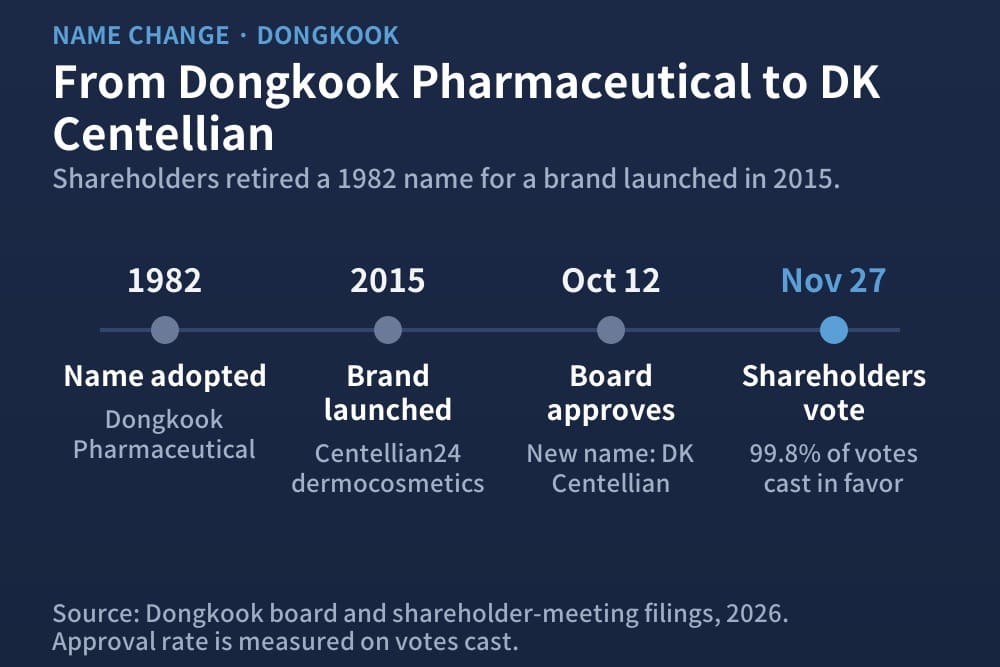
▲ A name adopted in 1982 was replaced on November 27, 2026, with 99.8% of the votes cast in favor.
Why would a drugmaker name itself after a cream?
Centellian24 launched in 2015 as a dermocosmetic brand, meaning skincare sold on dermatological credibility rather than on beauty-counter glamour. Its name comes from Centella asiatica, the plant behind Madecassol, the wound-care product that built Dongkook's reputation. The brand's flagship, Madeca Cream, is built on TECA, a standardized centella extract. Cumulative sales of the Centellian24 brand have passed ₩1 trillion (US$750 million).
The choice of word matters. Dongkook did not pick a neutral set of initials or an invented name. It picked the ingredient that links its drug heritage to its cosmetics. The word pharmaceutical leaves the name, and the pharmaceutical lineage stays inside it.
How large is the beauty business inside the old drug company?
Healthcare, the division that includes cosmetics, was the largest single segment in 2025 at 34.1% of ₩926.9 billion in revenue. Prescription drugs made up 24.6% and over-the-counter medicines 18.4%. Operating profit was ₩96.6 billion (US$72 million). In the first half of 2026, revenue reached ₩509.9 billion (US$382 million), up 11.5%, with operating profit of ₩53.4 billion up 12.6%.
The second quarter of 2026 shows where the weight is moving. Consolidated revenue was ₩258.9 billion (US$194 million). The healthcare division contributed ₩103.1 billion (US$77 million), up 29.9% and nearly 40% of the total. Cosmetics inside it brought in ₩81.0 billion (US$61 million), up 47.6% and about 31% of the quarter. Prescription drugs grew 10.5% and over-the-counter medicines 3.2%. Cosmetics grew more than four times as fast as the prescription business.
Overseas, the pace is steeper. Centellian24's overseas sales rose 566% in the second quarter from a year earlier. A base that small grows fast, and the percentage itself carries the message: the export business is young, and it is the part of Dongkook that moved most in 2026.
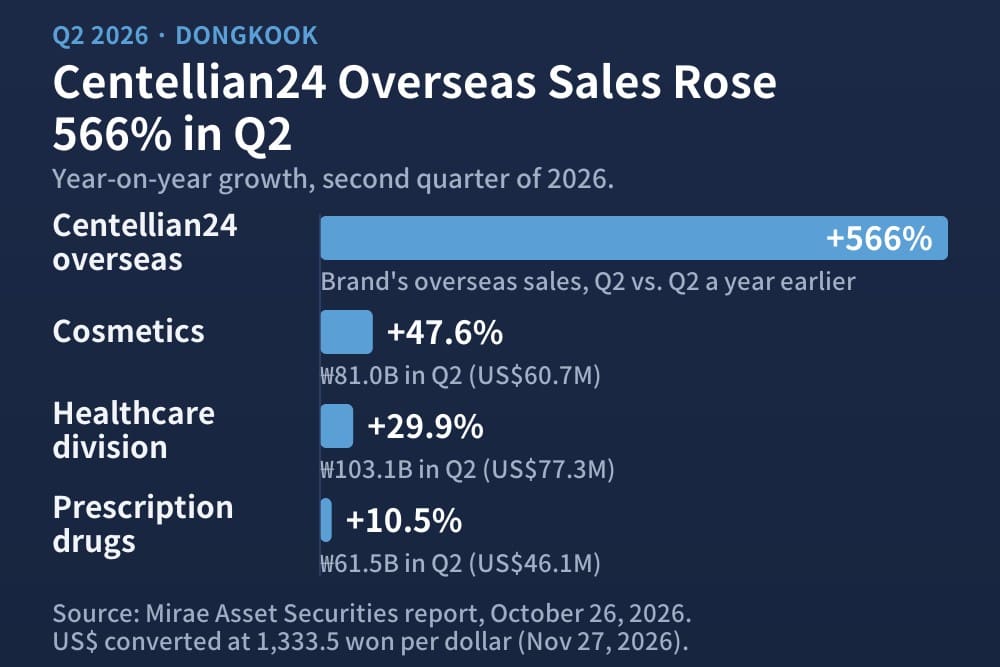
▲ Cosmetics grew 47.6% in the second quarter of 2026, against 10.5% for prescription drugs. Centellian24's overseas sales grew 566%.
What does the word "pharmaceutical" cost on a U.S. shelf?
Centellian24 reached Ulta Beauty in May 2026 with Madeca Cream Time Reverse and now sits in about 1,400 Ulta stores. In early June it opened in 89 Nordstrom locations and on Nordstrom's online store. In July it launched a 100 mL Madeca Cream Time Reverse at 200 Costco locations. Those are three different shoppers: a beauty specialist's customer, a department store's customer and a warehouse club's member. None of them is shopping at a drug company.
A shelf shows the brand. Everything behind the shelf, from purchase orders and distributor decks to retailer vendor files and press releases, carries the company's legal name. Dongkook said it is changing the name to meet customers worldwide, and an industry official quoted in Korean trade press said that domestically familiar names are hard to pronounce or remember abroad. A pharma label on the back office of a cosmetics business is friction that the brand no longer needs.
▲ Centellian24 announced its Ulta Beauty launch in June 2026. Image: Centellian24
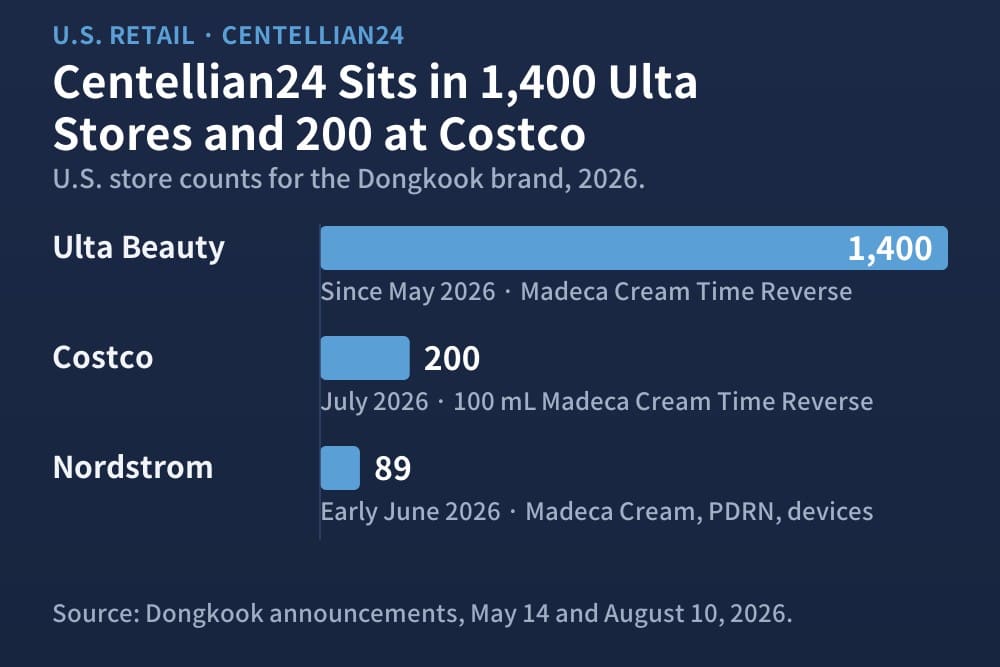
▲ Centellian24 sits in about 1,400 Ulta stores, 200 Costco locations and 89 Nordstrom locations in the United States.
How does Dongkook's choice compare with JW, GC and Boryung?
Other Korean drugmakers renamed earlier, and most moved to initials. JW changed its legal name to JW중외제약 in March 2011, after its former English name, Choong Wae, proved hard for foreigners to pronounce and led some to take it for a Japanese or Chinese firm. It keeps the Korean name Choong Wae at home and uses JW Pharmaceutical abroad. The Green Cross group adopted GC as its group brand in 2018, and its main company changed its English legal name to GC Biopharma in March 2022.
HK inno.N, formerly CJ HealthCare, took a new name in 2020 after Kolmar Korea (한국콜마) acquired it in 2018. Boryung dropped the Korean word for pharmaceutical from its name in 2022. Amorepacific is the older precedent outside pharma: in 2006 the company moved to a holding structure and gave the consumer business its own name.
Initials say a company is larger than one product. Dongkook's new name says the opposite. It puts a single consumer brand at the top of the company.
What does a name change involve for a company with three regulatory registers?
A drug, a cosmetic and a medical device sit in three separate regulatory systems, and Dongkook holds permits in all three. The name is therefore not a logo swap. It is a field in every register. The follow-up work includes the corporate registration and business registration, changes to the pharmaceutical manufacturing license, a manufacturing-site name-change permit from the regional food and drug safety authority with a processing period of 15 days, and updates to drug packaging, package inserts and manufacturing and quality-control documents. Permits for cosmetics and medical devices come under review as well.
The change does not affect existing drug approvals or insurance reimbursement status. That detail explains why the old name can go at all: what the regulator approved was the product, and the product stays.
Does a new name win deals?
JW and GC answer from opposite sides. JW introduced its new identity in 2011 under the slogan Jump to the World. Its 2018 licensing deal with Leo Pharma for JW1601, worth up to US$402 million, ended in April 2024 without a commercial product, and JW kept the US$17 million upfront payment. GC's Alliglo won U.S. FDA approval in 2023 and recorded U.S. sales above ₩150 billion (US$112 million) in 2025.
Both companies changed names. Only one built a product that sold. An industry official made the same point about Dongkook: a new name does not guarantee global competitiveness, because product strength and overseas sales prove a company's value in the end. For Dongkook, that product already exists, and its cumulative sales are above ₩1 trillion.
What happens when a brand outgrows the company that made it?
Dongkook is one of several Korean drugmakers that now run consumer beauty brands. Dong-A Pharmaceutical is widening its Pation line from Olive Young to Daiso and military base marts. Daewoong sells Ijdu, built on epidermal growth factor technology. Kwangdong's Celontia targets functional cosmetics. Ildong formed a joint venture, Ideanine, with the marketing firm Nine & Company to enter dermocosmetics. In each case, drug research funds the formula and a consumer brand carries it to the shelf.
Dongkook is the case where the brand carries the corporate name as well. The drug business still brings in more revenue than the healthcare division. The cosmetics business supplies the growth and, from November 27, the identity. The name is now a bet on the brand, and the brand has to keep earning it.