In October 2026, the Korean makeup puff brand KIMMY took part in a New York investor day run by Hashed, a blockchain venture firm, and Nurihouse, with Nomura's consumer banking team in the room. Nomura's managing director told the room that investors are moving from sales growth to conversion and repurchase rates. KIMMY's site leads with a repurchase rate above 49%. A puff that is washed after seven to ten uses is a product built to be bought again.
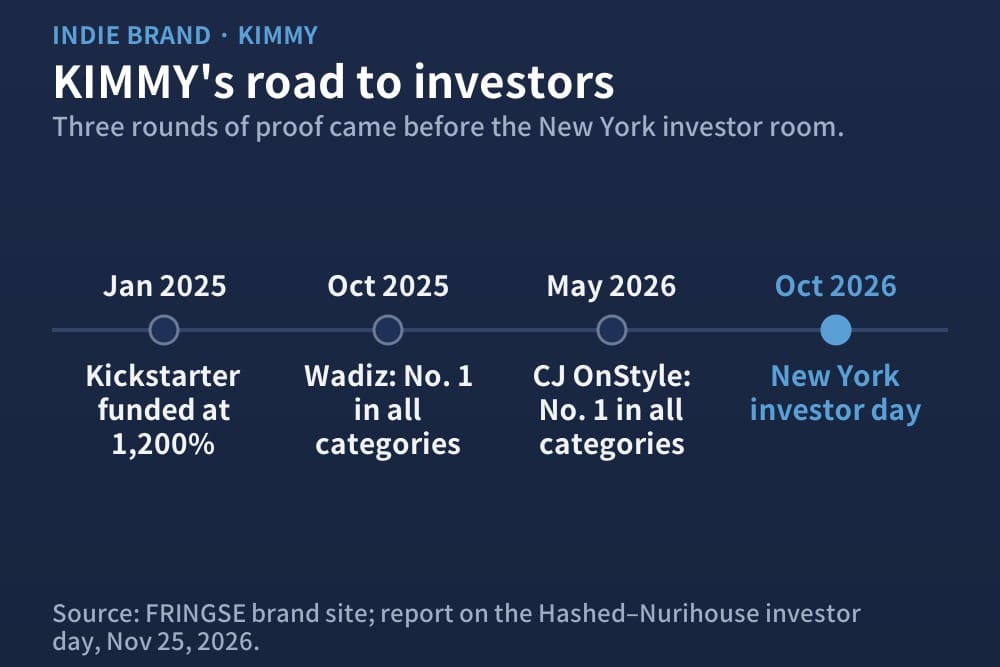
▲ KIMMY collected No. 1 rankings on Korean platforms and a Kickstarter funding rate of 1,200% before it reached a New York investor room in October 2026.
What does KIMMY sell?
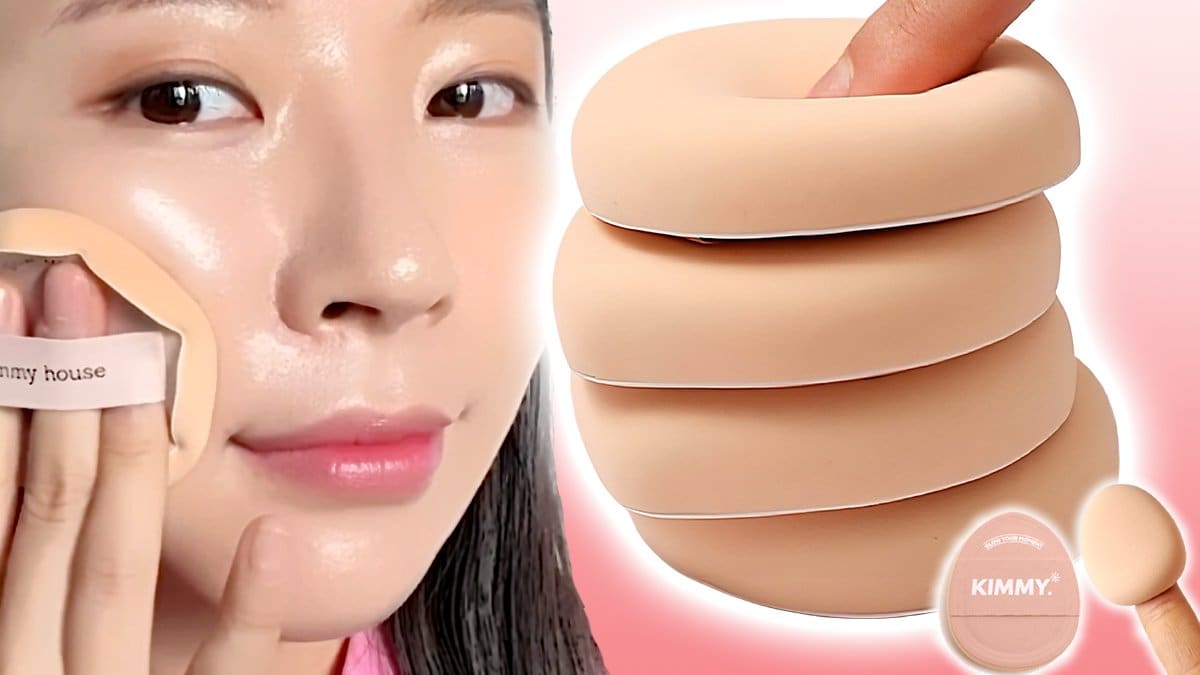
▲ FRINGSE's KIMMY Baby-Soft Glow Puff uses a three-layer structure and micro-coating designed for repeated washing. Image: FRINGSE Inc.
KIMMY is the brand of FRINGSE Inc., a Korean beauty startup, and it sells one product that carries the whole business: a makeup puff, listed in English as the Baby-Soft Glow Puff. Its shape is a squircle, a form between a square and a circle, and it carries a micro coating of 0.0001 mm that the brand says keeps foundation on the skin instead of inside the sponge. The final Wadiz campaign priced it at 16,000 won, about US$12 at 1,340 won to the dollar.
FRINGSE's site describes a thick three-layer cell structure with small pores that reduce foundation absorption, a double coating, and a 1 cm pressure-distributing sponge layer. The site lists a Korean patent for the puff dated January 2026. A sponge is the least glamorous item in a makeup bag, and the brand's pitch is that the sponge decides how much foundation reaches the face.
Why did a puff end up in front of New York investors?
Hashed and Nurihouse held a K-Beauty Investor Day in New York with the consumer and retail investment banking team of Nomura Holdings. More than 30 people attended, among them global beauty and consumer companies, growth equity investors, and New York venture firms. Four sessions covered North American entry cases, growth strategies, and investment trends, and five brands took part: KIMMY, HARUNA, VOESH, wolGlow, and FreeGo.
Nurihouse runs a K-beauty marketing and commerce platform and Haus of K, a Brooklyn program where about 50 brands have tested the market with local creators, buyers, and consumers. Hashed co-hosts the K-Beauty VC Conference within that program. The event puts brands, buyers, and capital in one room, and a tool brand sat among the five.
A sponge is an unusual product to bring to an investor room. The organizers' premise, in Hashed's words, is that US investors have had few chances to evaluate Korean brands directly, and a product with a patent, a price, and a repurchase rate is a brand an investor can evaluate in one meeting.
What did Nomura say investors measure now?
Kiran Rajasekaran, managing director of Nomura's consumer and retail investment banking group, said K-beauty is entering a growth phase centered on brand identity and IP, the intellectual property a brand owns. He said investors are shifting their key metrics from sales growth to conversion and repurchase rates. Paik Su-jin, senior investment principal at Hashed, said US investors have had few chances to evaluate Korean brands directly.
Conversion rate is the share of visitors who buy. Repurchase rate is the share of buyers who buy again. Neither depends on how fast a brand grows, and both depend on whether the product earns a second order. The diligence question points at the product, not at the marketing budget.
Why does a washable puff fit a repurchase metric?
FRINGSE's site lists a repurchase rate above 49%, and the Wadiz listing recommends washing the puff after about seven to ten uses. A sponge washed that often is also replaced on a cycle. The use instructions carry a replacement rhythm, the way a razor blade or a water filter does.
A serum is bought again when it runs out. A puff is bought again when it loses its shape, and that clock is faster and more regular than the clock for most skincare. The metric Nomura named and the product category line up, which is why a puff brand can present the number that investors now ask for before it has the scale of a skincare house.
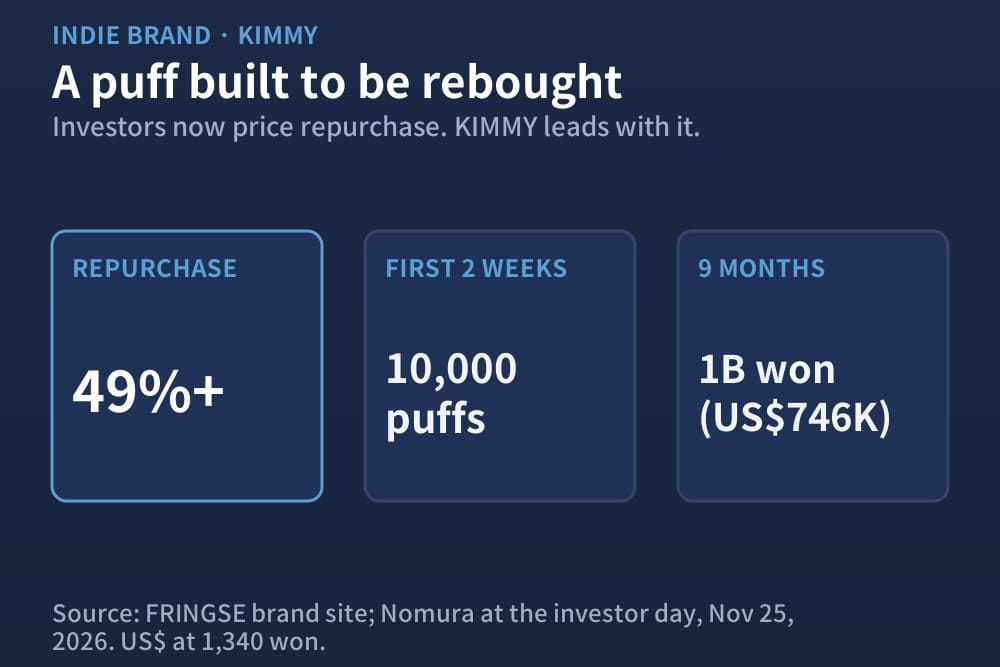
▲ KIMMY's site lists a repurchase rate above 49%, 10,000 puffs sold in the first two weeks, and 1 billion won (about US$746,000) in puff revenue within nine months of the domestic launch.
What did Korean platforms prove first?
The FRINGSE timeline stacks proofs in order. The site lists a Kickstarter funding rate of 1,200% in January 2025, and the No. 1 position across all categories on Kakao Makers in June 2025, on Wadiz in October 2025, on Musinsa in January 2026, and on CJ OnStyle in May 2026. It also lists 10,000 puffs sold two weeks after opening and 1 billion won (about US$746,000) in puff revenue within nine months of the domestic launch.
Each platform serves a different shopper: crowdfunding backers, a fashion marketplace, a TV shopping network. A product that tops the overall ranking on four platforms has been tested on four audiences. An investor reading that list sees the same result repeated by different crowds, which is closer to evidence than a single launch spike.
What does the US step add?
The FRINGSE site lists a selection by TikTok USA as a Korean cross-border company in November 2025. The investor day report places the puff 51st in Amazon's US beauty tools category. A US shopper who finds the product, buys it, and ranks it has done so without the Korean-market context that carried the earlier results.
Rank 51 in a tools category is a velocity marker, not a size marker. It tells an investor that the product sells across the border, and it is the first line of evidence that conversion survives the trip. The number sets the entry level for the conversation, and the repurchase data sets the rest. Together they give an investor two readings of the same product: one from a market the brand does not control, and one from a market where its first shoppers already come back.
How does the order of capital change in beauty?
The conventional order was capital first and proof second: a brand raised money to build its evidence. The KIMMY sequence reverses it. Crowdfunding supplies the first cash and the first demand signal at once, domestic platforms supply repeat evidence, Amazon supplies the foreign signal, and the investor day arrives last, when the brand can show numbers instead of a plan.
The New York program from Hashed and Nurihouse runs on that structure. Nurihouse tests brands in front of creators and buyers, and investors see the results. Hashed's stated aim is to connect US investors with Korean brands they have had few chances to evaluate directly.
For the investor, the new order changes the question. A growth curve invites a forecast. A repurchase rate invites a look at the orders already placed. The first asks whether the story is large, the second asks whether the product holds, and the second is the easier of the two to answer from a spreadsheet.
What does the puff say about the next wave of indie beauty?
KIMMY is a tool brand, not a skincare brand, and it earned its seat through a product that people use up. A category with a built-in reorder cycle hands investors the metric they now ask for at a stage when most brands still show growth curves. Conversion and repurchase turn a sponge into evidence, and evidence is what an investor day trades in.
The proof came first. The capital came last.