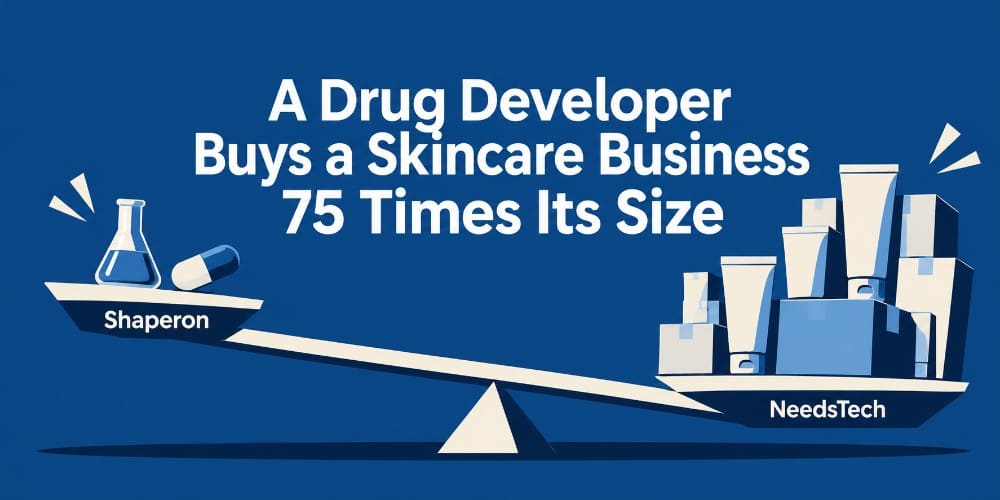
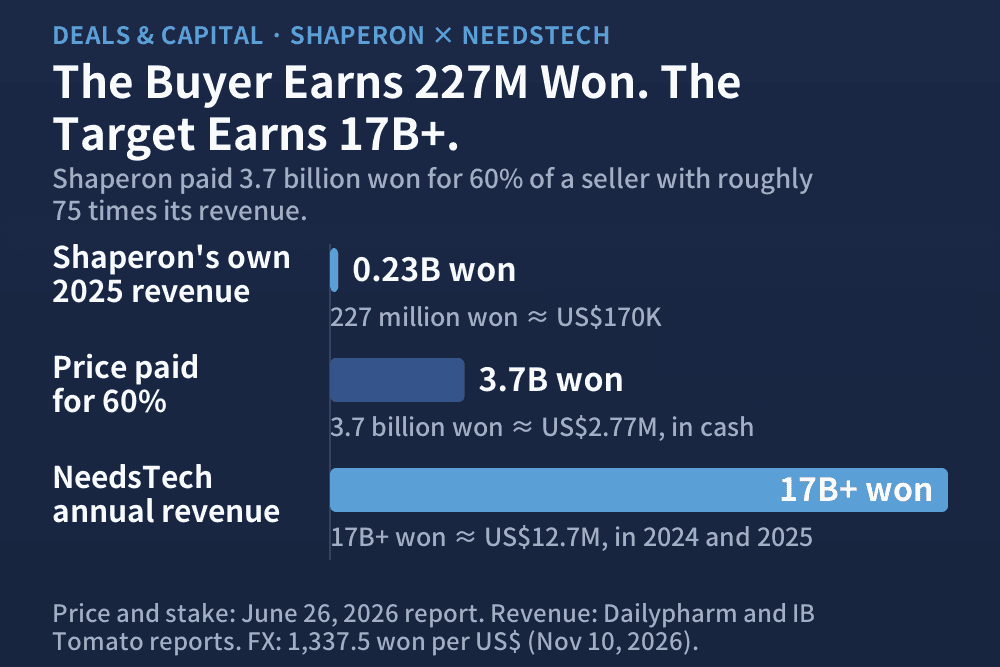
Shaperon, a Korean drug developer, reported 227 million won (about US$170,000) in revenue for 2025. On July 2, 2026 it completed its purchase of 60% of NeedsTech, a skincare and home-care seller with more than 17 billion won (about US$12.7 million) in annual revenue, for 3.7 billion won (about US$2.77 million) in cash. The target is roughly 75 times the buyer's size and sold for a third of one year of its sales. Biotech usually funds drugs with equity. Shaperon bought a cash engine instead.
What did Shaperon actually buy for 3.7 billion won (US$2.8 million)?
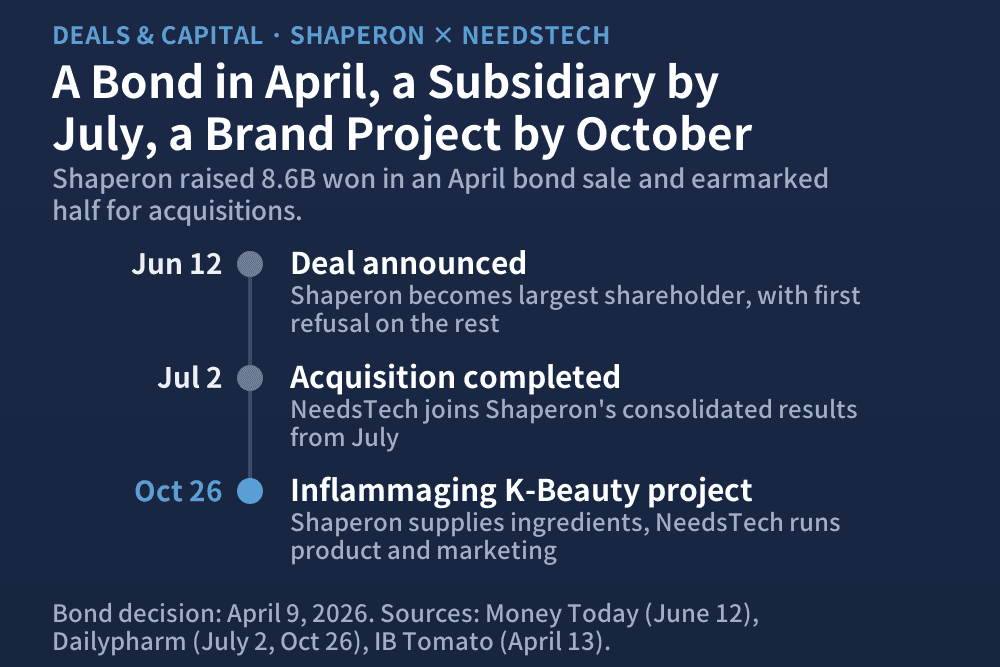
A June 26, 2026 report put the price at 3.7 billion won (US$2.8 million), paid as a lump sum in cash on July 1, for 60,000 shares held by NeedsTech's CEO, Jeon Sang-yeon. Jeon keeps the remaining 40% and stays on as co-CEO. A June 12 report added that Shaperon secured a right of first refusal on those remaining shares, a contract term that obliges the seller to offer the 40% to Shaperon before any third party.

The business sells under two brands, Hugrab in home healthcare devices and Bude in skincare. Its channels include corporate welfare malls, Electronic Land, Olive Young and Kakao Gift, plus its own online mall. It started in 2020 with 300 million won (US$224,000) in sales, reached 5.2 billion won (US$3.9 million) in 2023 and passed 17 billion won (about US$12.7 million) in both 2024 and 2025. The mall counts about 110,000 members, the KakaoTalk channel about 80,000 friends, and the site about 5 million visitors a year. Conversions in this article use 1,337.5 won per US dollar, the November 10, 2026 close.
The price implies about 6.2 billion won (US$4.6 million) for the whole company. Against 2025 revenue of more than 17 billion won (about US$12.7 million), Shaperon paid roughly 0.36 times annual sales for two brands, a customer file and a working D2C operation. D2C (direct-to-consumer) means the brand sells through its own site and app instead of through retailers.
Why does a drug developer with 227 million won (US$170,000) in revenue need a skincare company?
Shaperon's revenue was 227 million won (US$170,000) in 2025 and 17.7 million won (US$13,000) in 2024, according to an April 13, 2026 report, against an accumulated deficit of 132.3 billion won (US$98.9 million) at the end of 2025. A drug developer spends years on trials before a product earns anything. One program, Nugel for atopic dermatitis, has a final clinical study report from a global Phase 2b trial, the mid-stage test of whether a drug works at several doses.
The June 26 report tied the purchase to a KOSDAQ listing test. KOSDAQ, Korea's second stock market and the home of many biotech companies, flags a listed company as a monitored issue when its pre-tax loss grows large relative to its equity. Shaperon's ratio stood at 93.14% in 2024, 62.75% in 2025 and 16.7% in the first quarter of 2026, and the company has to hold it under 50% in 2026. A subsidiary with 17 billion won (about US$12.7 million) in revenue changes that arithmetic directly.
The financing was arranged in advance. Shaperon decided on April 9, 2026 to issue 8.6 billion won (US$6.4 million) of convertible bonds, debt that the holder can convert into shares, and earmarked 4.3 billion won (US$3.2 million) for acquiring other companies. The 3.7 billion won (US$2.8 million) price came in 0.6 billion won (US$449,000) under that earmark.
What does a price near a third of annual revenue say about the seller?
Shaperon's CFO, Kim Do-hyung, said the price was negotiated from a valuation by an external appraisal firm and that NeedsTech's D2C capabilities and synergies were the best fit among the candidates reviewed. He projected that the business adds roughly 20 billion won (US$15 million) in revenue and 2 billion won (US$1.5 million) in net income to Shaperon's 2026 consolidated results. Set against that net income, the 3.7 billion won (US$2.8 million) price equals under two years of earnings.
A D2C operator carries its value in machinery rather than in brand equity. NeedsTech launches an MVP (minimum viable product), reads the response, and only then moves to mass production and refinement. That loop, plus a customer file of 110,000 mall members and 80,000 chat-channel followers, is what a revenue multiple near 0.36 pays for. The sale priced throughput, not recognition.
The seller took cash for 60% and kept 40% together with a co-CEO seat. Jeon stays exposed to whatever the combined group builds, and Shaperon holds the first-refusal right to buy the rest.
What does the buyer put on NeedsTech's shelf?
Shaperon contributes five proprietary cosmetic ingredients, all registered in the ICID, the international dictionary that standardizes ingredient names. They come from anti-inflammatory technology Shaperon has developed over 20 years of drug research, a platform aimed at inhibiting inflammatory complexes. NeedsTech supplies product planning, branding and marketing.
On October 26, 2026 the two companies formalized the Inflammaging K-Beauty project. Inflammaging is the term for the idea that chronic low-grade inflammation accelerates aging. Kim Do-seon, a Shaperon executive vice president and NeedsTech co-CEO, said the project joins Shaperon's skin-science ingredient strength with NeedsTech's product development and marketing to start global expansion in earnest.
The first product is a peel-off cream, Truthion Spot-dam, launched in October 2026 with the ingredient RumiLua and three other care ingredients. Its sales target is 5 billion won (US$3.7 million) within a year of launch. That single product is aimed at 22 times Shaperon's entire 2025 revenue and about 29% of NeedsTech's annual base. Functional cosmetics, the Korean category that needs regulatory review for specific claims, follow in the first half of 2027.
Who runs the combined business?
Kim Do-seon, who previously worked at GC Biopharma, became NeedsTech co-CEO responsible for overall management, with a mandate to move the company toward a profitable structure and expand overseas. Jeon continues to lead sales and marketing. Two chief executives share one company, one from the buyer and one from the seller.
The division of labor is clean. Shaperon keeps the science in the parent and puts brand-building in a subsidiary that already sells 17 billion won (about US$12.7 million) a year. A Shaperon representative called the deal a strategic investment rather than simple diversification, and the first-refusal right on the remaining 40% gives Shaperon a route to full ownership without a bidding contest.
How far does the overseas plan reach?
NeedsTech's Hong Kong subsidiary has passed 1 billion won (US$748,000) in cumulative revenue, and the company has opened storefronts on Amazon in the United States and Japan. The stated target is overseas revenue above 10 billion won (US$7.5 million) in 2027, equal to about 59% of the 17 billion won (about US$12.7 million) base. North America runs through Hudson Therapeutics, Shaperon's U.S. subsidiary, working alongside NeedsTech's local entity.
The plan links the operator's own mall, Amazon and influencer channels into one D2C marketing system, Kim Do-seon said. No retail buyer sits between the product and the shopper in that design. A drug company's U.S. entity opens the door and a D2C operator's storefront takes the order.
What happens when a cash engine and a drug pipeline share one income statement?
Since July 2026, NeedsTech's results flow into Shaperon's consolidated financial statements, which add a subsidiary's full revenue to the parent's. Every quarterly report now shows a skincare number beside the clinical milestones. Investors who bought Shaperon for Nugel also own a stake in how many Truthion units ship.
The drug side runs on a different clock. Shaperon planned to attend BIO Japan to hold licensing talks with 12 global pharmaceutical companies after securing the Nugel study report. A licensor negotiating with 12 counterparties at once bargains better when the next payroll does not depend on a signature. The June 12 report framed the purpose that way: stable short-term revenue and cash flow from the beauty business to support pipeline research and global licensing.
What does the structure change for beauty brands and their buyers?
A familiar deal has a beauty group buying science to support its prices. Here the owner of the science bought the customer. Brands in the same aisle now face a rival whose parent measures success in drug milestones and treats skincare as working capital.
The first test is arithmetic. The Truthion target of 5 billion won (US$3.7 million) is 29% of the subsidiary's annual base, and the 2027 overseas goal is 59%. If both land, the cash engine reaches the size its role requires. If they miss, the listing math returns to the parent. Either way, the structure is set: the drug company sells skincare so that it can keep making drugs.